top of page
Teaching Tomorrow: The Rising Importance of Sustainability Education
In a world facing climate change, biodiversity loss, and resource scarcity, education has a critical role to play — not just in informing, but in transforming. Sustainability education is more than a classroom subject. It’s a mindset shift. It’s about preparing young minds to become responsible stewards of the planet and empowered problem-solvers for global challenges.
What is Sustainability Education?
Sustainability education, often referred to in the UK as Education for Sustainable Development (ESD) or Sustainability and Climate Change education, teaches learners how to make decisions that protect the environment, promote social equity, and support economic well-being — now and for future generations.
It combines:
-
Environmental literacy
-
Ethical reasoning
-
Systems thinking
-
Action-oriented learning
It’s not just about what students know — but what they do with that knowledge.
Why It Matters More Than Ever in the UK
1. Equips Learners for Global and Local Challenges
From plastic pollution in our oceans to food security and energy transitions, students must understand the interconnectedness of environmental, social, and economic issues, both globally and within their local communities across the UK.
2. Encourages Active Citizenship
Sustainability education nurtures critical thinkers and compassionate leaders who participate in civic life and advocate for change, aligning with the UK curriculum's aim to prepare students for life in modern Britain.
3. Aligns with National and Global Goals
The UK government has embedded sustainability into its Sustainability and Climate Change Strategy for education, directly supporting the United Nations' Sustainable Development Goals (SDGs).
4. Builds Lifelong Skills
Collaboration, innovation, empathy, and problem-solving are all part of sustainability learning — skills highly valued by UK employers and essential for the future green economy.
How UK Schools and Colleges Are Implementing It
-
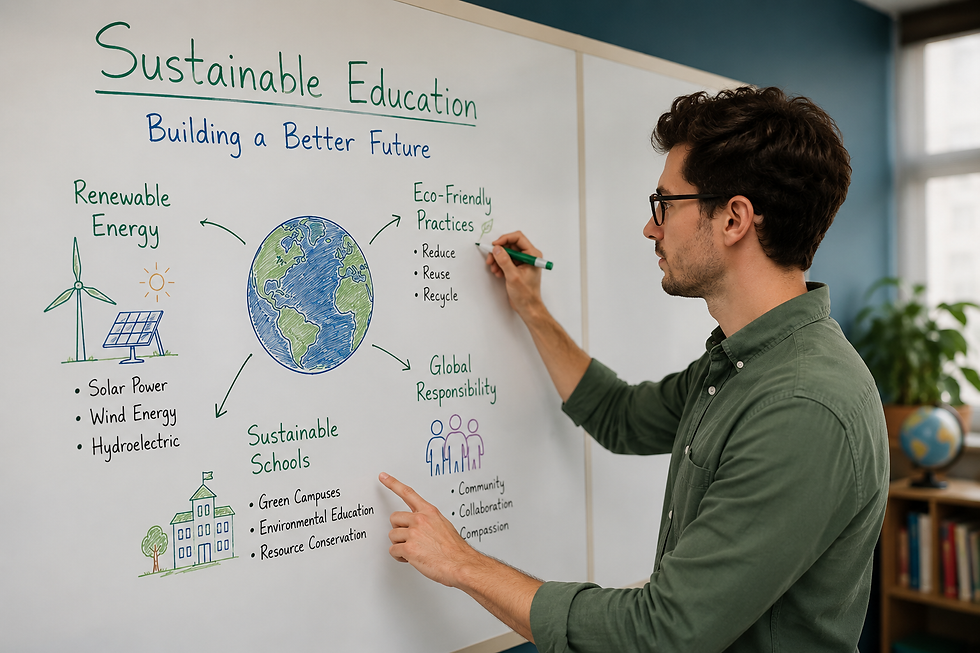
Green Campus Initiatives: Student-led waste segregation, tree-planting drives, water conservation, and energy audits to achieve Eco-Schools Green Flag status.
-
Curriculum Integration: Weaving climate studies, biodiversity, and sustainability into the National Curriculum across subjects — from GCSE Sciences and Geography to A-Level Economics and PSHE.
-
Project-Based Learning: Students designing eco-friendly products, conducting litter picks in local parks, or tracking their school's carbon footprint as part of a National Climate Action Award.
-
Partnerships and Campaigns: Collaborating with local Wildlife Trusts, The National Trust, and council-led recycling programmes for real-world environmental action.
-
Sustainable Infrastructure: Installing solar panels, rainwater harvesting systems, and creating biodiversity gardens on school grounds.
Examples of Sustainability in Action in the UK
-
A school in Bristol where students manage a vegetable garden and learn about sustainable agriculture with the Royal Horticultural Society (RHS) Campaign for School Gardening.
-
A college in London organising a mock-COP26 summit where students pitch green innovations to local MPs.
-
A curriculum that includes workshops on the SDGs, school-wide plastic-free initiatives, and projects on eco-entrepreneurship.
What Students Gain
-
Eco-literacy: A deep understanding of natural systems and the climate crisis.
-
Resilience: The ability to cope with environmental and social challenges.
-
Agency: The confidence and skills to lead change — whether in their home, university, or future career in the UK's growing green sector.
The Future of Sustainability Education in the UK
As the focus on climate and nature intensifies, sustainability education will evolve to be:
-
Firmly embedded in the National Curriculum and inspection frameworks like Ofsted.
-
Deeply interdisciplinary — connecting arts, technology, business, and the humanities.
-
Technology-enhanced — using data analytics and simulations to understand complex systems.
-
Community-driven — involving parents, local councils, and businesses in a collective effort.
Final Thought:
Sustainability education is not just about saving the planet — it’s about redefining how we live, learn, and lead. It cultivates a sense of purpose in students and empowers them to shape a future for the UK that is fairer, greener, and more resilient.
Let’s not wait for change. Let’s teach it.

bottom of page